Physicalising a Cloudy Landscape – a Symbolic Modelling Case Study
by Marian Way in Client Stories, Modelling, Symbolic Modelling

When James Lawley and I run our Advanced Fine Tuning workshop as an in-person event, we like to make the most of the in-person aspect by encouraging clients to physicalise their metaphor landscapes. With so much training and coaching happening online these days, some of our participants have never had the opportunity to experience or learn how to facilitate in this way – and it can be quite different from an online session.
During a recent workshop, the first person to take the role of client was quite surprised to be treated to the standard opening questions for in-person facilitation: “Where would you like to be?” and then “Where would you like me (i.e. the facilitator) to be?” (And, because we had a roomful of people, “Where would you like the others to be?”) She said she felt like she was being given a lot of power. As the workshop went on, though, the clients didn’t even need to be asked where they’d like to be; they were quite happy taking the reins and organising the people – and the furniture – for themselves.
Our case study relates to the last session of this workshop, which starts with the client positioning herself close to the flipchart and using it to write some notes and draw a diagram so she can articulate what has been happening and what she wants to bring to the session. She draws and describes an unwelcome ‘cloud’ that comes over her whenever she has to make difficult decisions or think about money, and she says she’d like to get rid of all the clouds in her life and to have a clear view.
The flipchart is positioned at one end of the room facing the window, and as she speaks, she’s standing on the edge of a large mat. The facilitator is positioned off to one side.
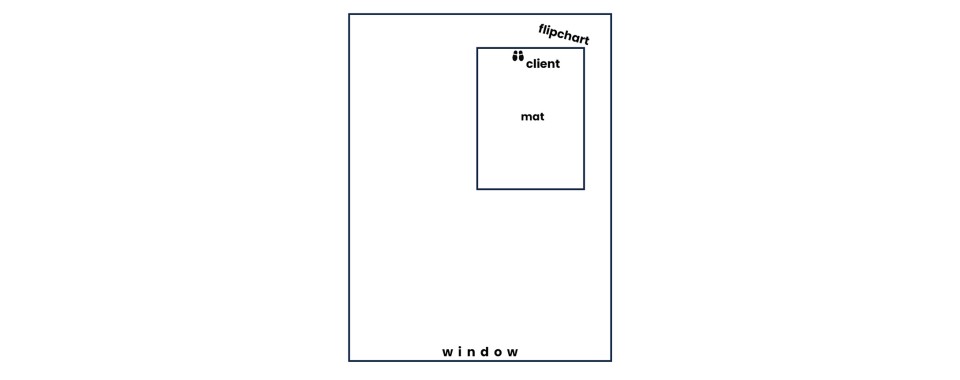
As she is asked clean questions, she explains that being in the cloud is like driving through fog: if you look at fog from a distance, it has a boundary, but if you’re in the fog, you become short-sighted and can’t perceive the boundary. Such is the nature of clouds.
Next, she speaks about how she wants clarity: “to be able to see the view”. She describes clarity as being easy, sunny and bright and when asked, “Whereabouts is clarity?” she points through the window to somewhere in the distance. And as she looks in that direction, she becomes aware that when she has clarity (most of the time) she can see the overview and the details of a situation. But, “As soon as I am in the cloud, I don’t see clearly and can’t make decisions”.
Notice how the client is making use of the qualities of the actual room to describe / experience her metaphorical landscape. The view she is seeing in her metaphor is the real view out of the window. The actual and the metaphorical are blending into one.
When the facilitator asks, “What happens just before cloud?” the client takes two steps back. (Until this point, her feet had been just on the edge of the mat.) It seems likely that the client is using the mat to represent the cloud, although whether she’s doing this consciously or not, we don’t know.
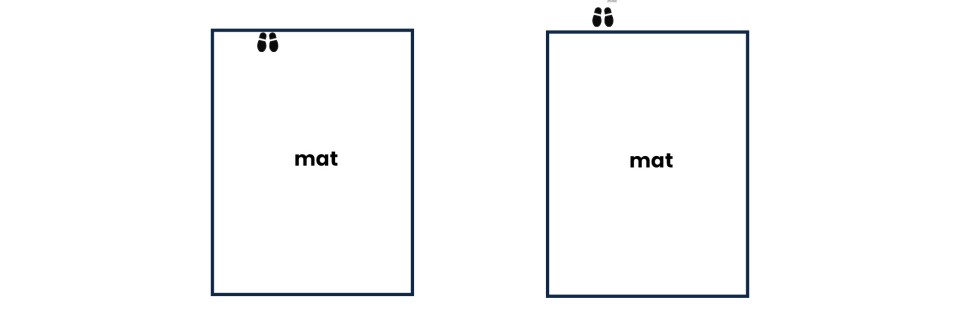
“It’s clarity,” she says, then “Something happens. Sometimes it’s fast, sometimes gradual.” She takes a step forward, back onto the mat. “I don’t understand. I think I should.”
Next, she puts attention on the stepping. She asks herself, “Do I step in or does the cloud come to me?” a question she answers with “I’m where I am – the cloud comes and goes all over me. It inhibits my thinking and clear logic. I spend too much time in it and I still haven’t solved my task. I walk out from the cloud but part of me is still in it.”
At this point, James suggests a couple of questions to the facilitator:
“How many times have you been in this cloud?”
“Innumerable,” says the client.
“And where is that knowledge of all those times?”
“In my heart and my brain. I get angry. It’s so stupid…”
The realisation that she’s been in the cloud ‘innumerable’ times makes the client angry. “The anger is not unwelcome – it could be a resource – but I don’t know how to use it. How can I reduce the probability of the cloud coming over me?”
Now the facilitator summarises the client’s current predicament and asks,
“And when all of that, what would you like to have happen?”
“I said I’d like the cloud to go away, but that’s a defensive move. I want to take action.”
Then, after a few more sentences of explanation, the client says, “I want to move the mat.”
And, without any further questioning, she does just that. She takes ‘her’ end of the mat and rolls it up, leaving just a couple of feet unrolled.

“Now it’s an obstacle. I can’t just go into the cloud. I have to actively take a step over the obstacle and I don’t want to do that.”
The question of whether the client was previously stepping into the cloud or it was coming to her no longer matters. It’s definitely all about stepping now.
After this mat rolling move, I stop making notes. Until this point, I have been splitting my attention between the client and the spatial configuration of the landscape, and writing my notes. Now, the whole thing has become so psychoactive (the client relating to their symbols and the space around them in a way that suggests the metaphor is real) that all the information I need to be able to follow along (or intervene if necessary) is right in front of me. The client now has what Penny Tompkins would call, “an all-singing, all-dancing 3D metaphor landscape”. It’s enthralling – and it also means I don’t have any more verbatim quotes from the client that I can share with you.
So what happens next? The client starts kicking the mat, which has become an ‘obstacle’ to going into the cloud. After a short while, she realises that she could take a route around the mat to avoid the cloud. She practices walking around the mat a few times.

It seems that the client has a solution to her ‘cloud’ problem – and this could have been the end of the session. But James isn't done. He suggests a few questions that take the client back to the time (and place) just before she takes the detour and that invite her to consider what needs to happen for her to make that decision to go around the cloud-mat as opposed to going towards it and either kicking it or stepping over the obstacle part and right into the cloud.
As the client approaches the mat, she’s at what we call a ‘choice point’. She realises that, as she approaches any ‘cloud-like’ task, she will need to stop and pause. And what will encourage her to do that? What kind of pause? The best way to help the client to remember to stop and pause is to develop the word ‘pause’ into a symbol with a name, location and some attributes. In this way, ‘pause’ turns into a railing with metal poles and white rope between the client and the mat, which means she has to stop. The client also realises that the railings could be extended to go around the mat, so leading her on her chosen route, by-passing the cloud. Of course, this is a metaphorical railing, but just as psychoactive as the cloud-mat – as the client practises walking towards the cloud-mat, it still has the effect of stopping her in her tracks.

What will the client do in this pause when she is back in her real life? She says she will take a break, have a coffee or make a phone call, and will then set her Pomodoro to 25 minutes to ensure there’s absolutely no chance of being stuck in a cloud for a whole day. And with this return to ‘real life’ thinking, the session comes to an end.
Witnessing a session such as this is a bit of a ‘treat’ nowadays. Working online, it’s easy to forget just how spatial this work is. I am always encouraging facilitators to ask more ‘where’ questions, to locate all the symbols and to help the client to develop an embodied metaphor landscape. Of course, staying clean goes a long way; a facilitator who asks good clean questions will always serve their client well. But there's nothing like watching a client take hold of a mat and roll it up – quite spontaneously – to reinforce the fact that this is spatial, embodied, work and, if we get bogged down in our notes and forget about locating everything, what results can be less than what’s possible – whether we’re working online or in-person. A few weeks after the session, I heard back from the client: "The next time I had to do my accounting, it took less than 25 minutes instead of a whole day – and with less 'cloudiness' than the time before. The cloud is still there sometimes, but I have become more aware of it and how the railing will help me go around it."
It's worth noting that the cloud hasn't gone. At the start of the session, the client said she wanted to get rid of all the clouds in her life, but that's not what has happened. What’s changed is her relationship to the cloud: she can now see it coming, pause at the railing, and choose a different route. Whether that's better than getting rid of the cloud altogether is a question only she can answer, but the evidence suggests it's working.
Photo by engin akyurt on Unsplash
Diagrams © Marian Way
Related blog posts

Clean Constellations
30th Mar 2024
Related courses
About Marian Way

A highly skilled facilitator and trainer, Marian, who founded Clean Learning in 2001, has developed and delivered training across the world. She is the author of Clean Approaches for Coaches, co-author, with James Lawley, of Insights in Space and co-author, with Caitlin Walker, of So you want to be… #DramaFree.
Marian is an expert Clean facilitator, an adept modeller, a programme writer and an inspirational trainer. She has a natural ability to model existing structures, find the connections between them and design new ways for people to learn. Marian was a leading innovator within the Weight Watchers organisation, which included developing the “points” strategy, a local idea that went on to become a global innovation. She is a director of both Clean Learning and Training Attention CIC, world leaders in clean applications for corporate, educational and community development. She designs our programmes and workbooks, leads workshops and teaches on all our courses. She’s trained people in Great Britain, Russia, Sweden, Germany, Australia, Japan and the USA. Marian is also a recognised Clean Assessor.
- Blog categories
- A - Z of Clean
- Adventures in Clean
- Book Reviews
- Business
- Clean Ambassadors
- Clean Interviewing
- Clean is like ...
- Clean Language
- Clean Language Questions
- Clean Space
- Client Stories
- Coaching
- Creativity
- #DramaFree
- Education
- Health
- ICF
- Life Purpose
- Listening
- Metaphor
- Modelling
- Outcomes
- Practice Group
- Symbolic Modelling
- Systemic Modelling
- Training